Many real estate teams don't fail the EU Taxonomy on the substantial contribution criteria. The energy performance thresholds are demanding, but they're clear: an EPC, a primary energy demand figure, a top 15% benchmark. You either meet them or you don't.
Where alignment quietly falls apart is one layer down, in the Do No Significant Harm (DNSH) criteria, and specifically in the check for climate change adaptation. It's the criterion that asks a question most portfolios have never answered in a structured way: do you actually know how and to which financial extent physical climate risk affects this building, and what have you done about it?
If your team is preparing Taxonomy disclosures for financing and investment committees, or if your lenders are starting to ask for alignment evidence at the asset level, this is the check worth getting right first. Here's how it works, where it goes wrong, and how to turn it from a compliance hurdle into an underwriting advantage.
What the DNSH adaptation check actually requires
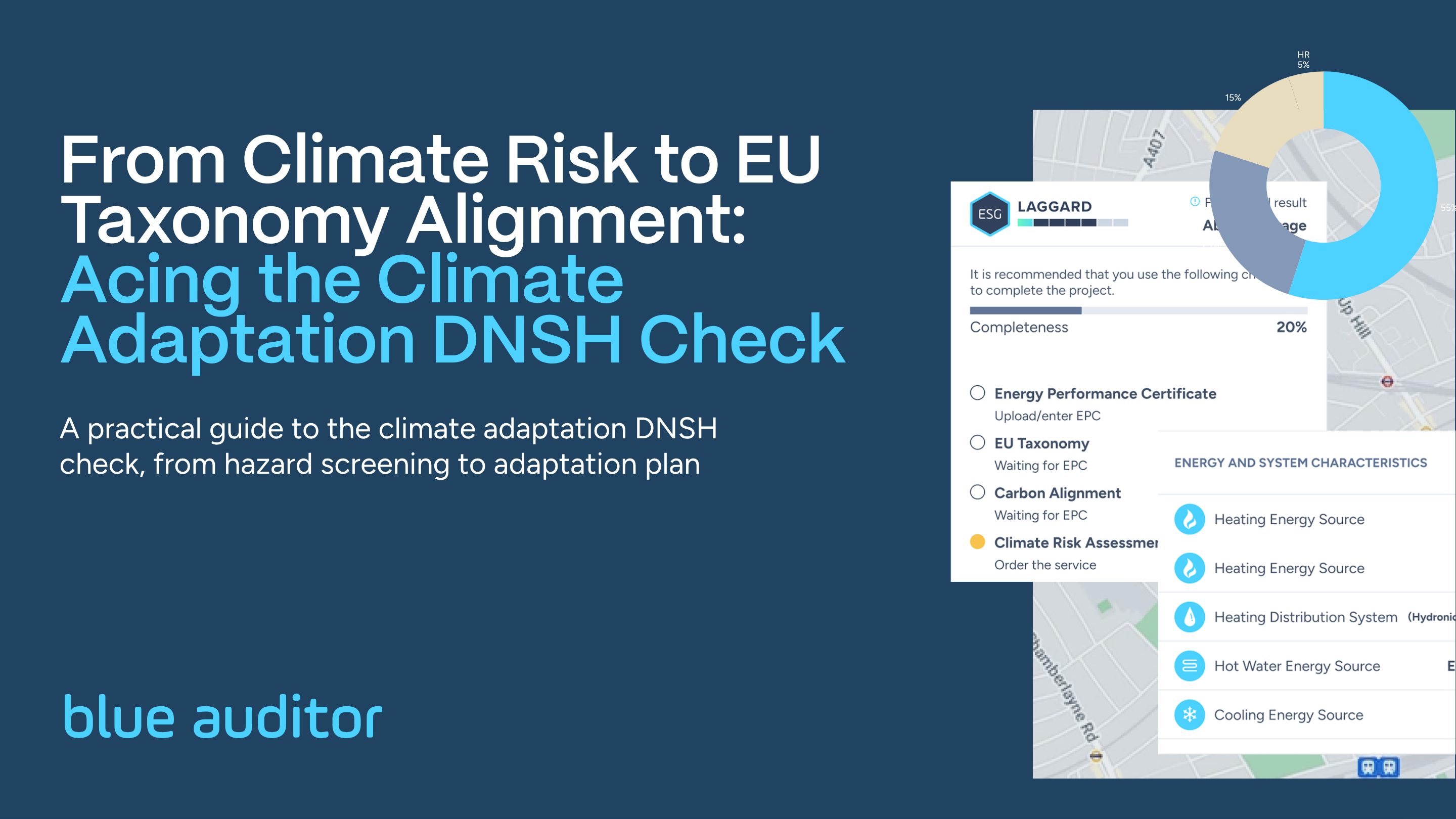
For activities contributing substantially to climate change mitigation (which covers most real estate activities: acquisition and ownership, renovation, new construction), the DNSH criterion for adaptation points to Appendix A of the Climate Delegated Act. In practice, it requires a Climate Risk and Vulnerability Assessment (CRVA) for the asset.
Strip away the regulatory language, and the CRVA is a four step exercise:
1. Screen the hazards. The Taxonomy provides a classification of climate related hazards, chronic and acute, spanning temperature, wind, water, and solid mass. That means everything from heat stress and changing precipitation patterns to flooding, storms, subsidence, and wildfire. The screening must identify which of these hazards could affect the performance of the specific asset - not just a random address - over the expected lifespan of that particular asset. Not the portfolio in general. Not the country. The asset. Think about it from a risk-management perspective.
2. Assess materiality. Of the hazards identified, which ones are actually material to this building? A logistics asset on a floodplain and an office tower in a dense urban heat island face very different risk profiles, even in the same city. Materiality depends on location, construction, use, and remaining lifespan. Even more detailed aspects such as the location of mechanical and electrical equipment can have a very different material impact.
3. Use science, not intuition. For assets with an expected lifespan beyond ten years, which is essentially all real estate, the assessment must draw on state of the art climate projections across a range of scenarios, at the highest resolution available. A qualitative note that "flood risk was considered" won't survive an audit. An assessment that is purely based on historical statistics does not fulfill the requirement either. Assessors and auditors increasingly expect scenario based analysis grounded in recognized, forward-looking climate models, consistent with the asset's holding period and beyond.
4. Identify and implement adaptation solutions. This is the step teams most often miss. If the assessment surfaces material risks, the criterion requires adaptation solutions that substantially reduce them, backed by an implementation plan. A risk register isn't enough. The DNSH check is only passed when material exposure is met with a credible, documented response.
Where portfolios get stuck
On paper, four steps. In practice, three recurring failure points.
The data is fragmented. A defensible CRVA needs asset master data (location, construction year, structure, use), technical building data, and often EPC and audit evidence. All of it usually sits scattered across spreadsheets, property managers, and PDFs. Before the climate analysis even begins, teams spend weeks assembling and reconciling inputs. At portfolio scale, this is where CRVA programs stall.
The screening doesn't scale. Commissioning a bespoke consultant study per asset works for a handful of trophy buildings. It doesn't work for 200 assets across multiple countries, each needing hazard screening against high resolution climate projections under multiple scenarios. Without a systematic, repeatable methodology, portfolios end up with inconsistent assessments that can't be aggregated or compared at fund level.
The evidence trail is thin. Taxonomy alignment isn't a self declaration anymore. Under recognized governance standards, alignment figures sit inside audited sustainability statements. Auditors want to see the hazard list that was screened, the scenarios and data sources used, the materiality logic, and the adaptation measures with their implementation status. In a nutshell: sustainability and climate risk linked to financial, material realities. If your CRVA lives in a consultant's PDF from 2022 with no underlying data, expect uncomfortable questions.
Sound familiar? If any of these three describe your portfolio, it's worth seeing how a systematic, platform based CRVA works in practice. Book a 30 minute demo and we'll walk through it on a live portfolio.
The reframe: DNSH as an underwriting signal
Here's the shift worth making. The CRVA that the Taxonomy demands is, in substance, the same analysis that credit committees, insurers, and acquirers increasingly run themselves, just with different labels. Physical hazard exposure, expected damages, climate Value at Risk, resilience measures and their cost.
Which means the adaptation DNSH check is not paperwork produced for a disclosure. Done properly, it produces intelligence that flows directly into:
- Underwriting and valuation. Climate VaR at asset level informs pricing, hold or sell decisions, and lender conversations.
- Capex planning. Adaptation measures identified in the CRVA compete for the same budget as energy retrofits. Assessing them together, with cost, impact, and payback, is how you build one coherent asset pathway instead of two parallel wish lists.
- Reporting reuse. The same evidence base serves Taxonomy DNSH, CSRD's ESRS E1 resilience disclosures and GRESB's climate risk components. Capture once, report to many.
Teams that treat the CRVA as a one off compliance artifact pay for it repeatedly. Teams that treat it as a living, asset level dataset pay for it once and use it everywhere.
Getting it right, operationally
A workable approach at portfolio scale looks like this:
- Build the asset baseline first. Consolidate master data, EPCs, technical documentation, and consumption data in one governed workspace, validated and normalized. Every downstream analysis (risk, alignment, retrofit) reuses the same records.
- Screen systematically, then go deep selectively. Run all assets through a consistent hazard screening using high resolution climate projections across scenarios. Let the screening triage the portfolio: most assets clear with documented low exposure, and the material cases get deeper analysis and adaptation planning.
- Quantify in financial terms. Translate hazard exposure into expected impact and climate VaR. It makes materiality decisions defensible, and it makes the results legible to the people who allocate capital.
- Close the loop with measures. For material risks, define adaptation solutions with owners, costs, and timelines, and track implementation. This is what converts an assessment into a passed DNSH check, and a risk into a managed one.
- Keep the audit trail native. Every figure in your Taxonomy disclosure should trace back to source data, methodology, and evidence, without a forensic reconstruction exercise at year end.
The bottom line
The climate adaptation DNSH check has a reputation as the awkward, technical corner of Taxonomy alignment. It doesn't have to be. The regulation is effectively asking real estate owners to do what disciplined investors should want to do anyway: understand physical climate exposure at asset level, quantify what it costs, and act on what's material.
Get the data foundation right, make the assessment systematic and scenario based, and connect the results to your retrofit and capital planning. The DNSH check stops being a hurdle. It becomes one more output of a portfolio that already knows itself.
The fastest way to judge whether it fits your setup is to see it live. In a 30 minute demo, we'll take a sample of your assets (or a representative portfolio) and show you:
- how hazard screening and materiality assessment run across scenarios,
- what the climate VaR and adaptation outputs look like at asset and fund level, and
- how the same evidence base feeds Taxonomy, CSRD and GRESB reporting without double entry.
.jpg?width=400&upsize=true&name=blogss%20visuals%20(1).jpg)