What is driving that hesitation is not a lack of opportunity. It is a lack of visibility.
For investors and asset managers, the challenge is no longer simply identifying assets with attractive fundamentals. The harder question is which assets will remain viable, liquid, and financeable as transition risk becomes more financially material. That question is becoming more difficult to answer with traditional tools, and it is precisely where value can be lost when decisions rely on incomplete or overly simplified information.
In many cases, the market is not missing ambition or capital. It is missing decision-useful clarity at asset level. Stakeholders need to understand what a building's actual risk profile looks like, what interventions may be required, what those interventions could cost, and how those decisions may affect value over time.
That is where a growing gap is emerging in the market between broad sustainability narratives and the level of analysis needed for real capital decisions.
Why your current visibility is probably not enough
Many real estate decisions are still being made with a partial view of future exposure. On the surface, an asset may look solid. The location works, income appears stable, the tenant profile is acceptable, and the numbers hold together in a conventional underwriting model. But that is no longer enough to understand whether the asset is truly worth holding, refinancing, or acquiring.
What increasingly matters now is whether you can see beyond current performance and assess future resilience with confidence. If you cannot quantify transition risk clearly, then you are not only carrying technical uncertainty. You are carrying valuation uncertainty, financing uncertainty, and strategy uncertainty.
That uncertainty often comes from the limits of the data and methods currently used across the market:
- EPC labels often do not reflect actual operational performance
- Retrofit costs are frequently estimated too broadly to support investment decisions
- Regulatory exposure is discussed conceptually but not translated into asset-level financial impact
- Portfolio reviews often rely on averages and benchmarks that hide building-specific realities
This leaves many investors in a difficult position. They can sense that risk exists, but they cannot measure it well enough to act decisively. As a result, decisions are delayed, pricing becomes more conservative, and potentially strong assets may be overlooked simply because no one has enough visibility to understand them properly.
This is where the cost of poor clarity becomes real. When you do not know what an asset truly requires, you cannot confidently plan CapEx, model transition pathways, assess hold strategy, or determine whether a building is mispriced, manageable, or genuinely exposed.
How to build a decarbonization retrofit roadmap
Good transition planning in real estate starts with a roadmap, not a wish list. A decarbonization retrofit roadmap sequences interventions by impact, cost, and feasibility, so capital is deployed in the right order rather than all at once. In practice, building a roadmap means three things.
First, establish a credible baseline using actual energy and emissions data, not just an EPC label. Second, plot the asset against a science-based decarbonization pathway. Frameworks such as CRREM (Carbon Risk Real Estate Monitor) define the emission intensity trajectories an asset must follow to stay aligned, and the point where it falls behind is when CRREM stranding risk begins. Third, translate the gap into a phased intervention plan with realistic CapEx ranges and emissions reduction potential for each step.
This approach also aligns with EU policy direction. The EU Renovation Wave aims to at least double building renovation rates across Europe, which means retrofit planning for real estate portfolios is moving from optional to expected. Transition planning to avoid stranded assets is, increasingly, simply prudent asset management. For a deeper view of how these decisions flow through to value, see our analysis of moving from lifecycle CapEx to valuation and our guide to achieving net zero goals with CRREM.
Why Blue Auditor is different
Blue Auditor does not treat buildings as averages. It treats them as individual assets with their own technical conditions, energy behavior, retrofit needs, and financial implications.
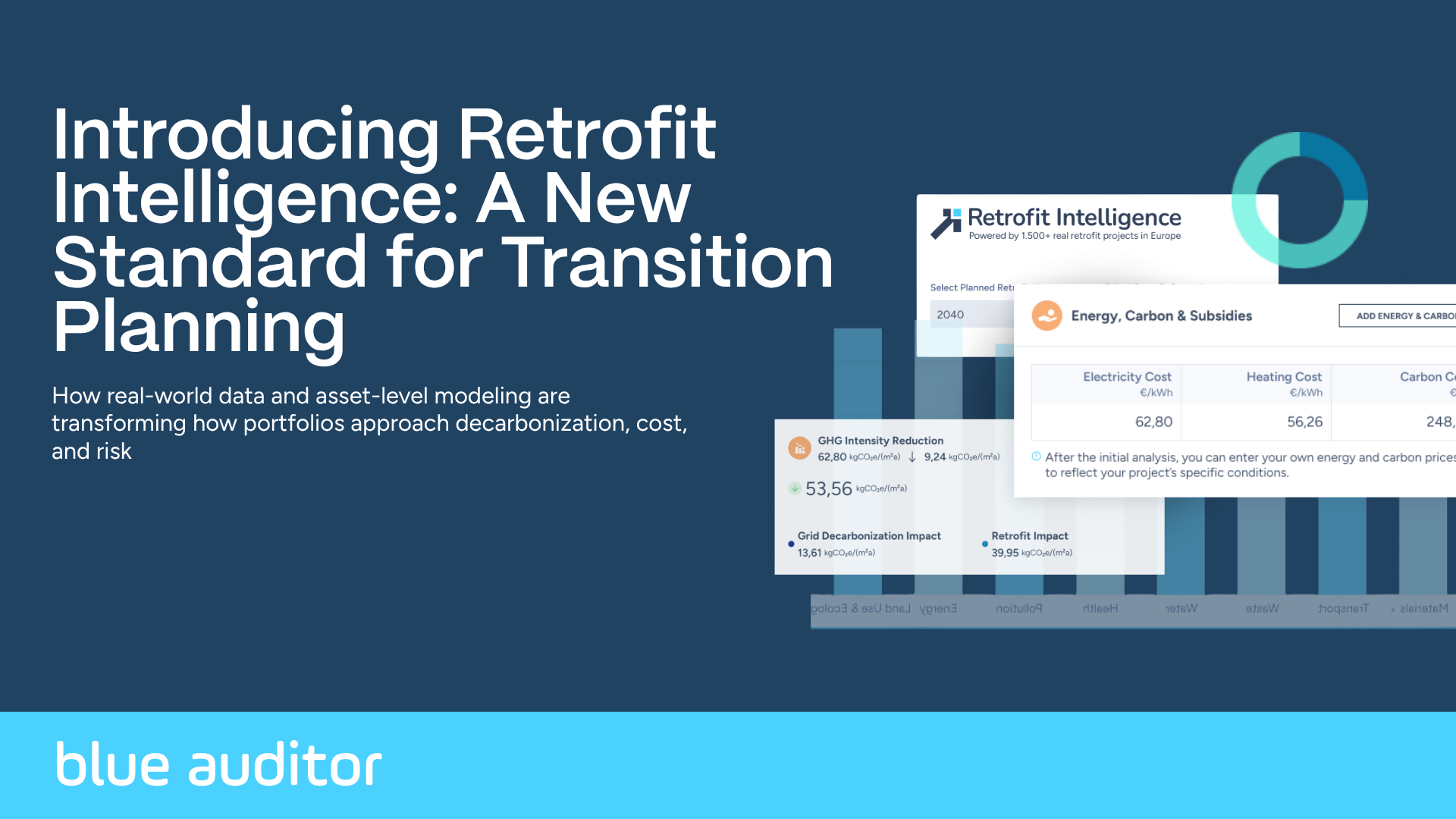
Through Retrofit Intelligence™, Blue Auditor provides bottom-up, asset-specific transition modeling grounded in real-world building data and a large European dataset of retrofit outcomes. That allows investors, lenders, and asset managers to see not only where exposure exists, but what can realistically be done about it and what that means financially.
For customers, that value is immediate and practical.
With Blue Auditor, you can:
- Identify which assets are likely to remain viable under future regulation
- Quantify transition risk at the building level instead of relying on portfolio-level assumptions
- Estimate realistic retrofit pathways, costs, and emissions reduction potential
- Understand how technical interventions affect investment strategy, refinancing, and exit planning
- Prioritize capital where it will protect value most effectively
That is a much stronger position than simply knowing that "something will need to be done." It gives you the visibility to decide what to do first, how much to invest, and where the real risk sits. This is the core of capex planning for decarbonization: matching each euro of investment to the asset and intervention where it protects the most value.
This is especially important in a market where waiting can be costly. Poor visibility does not just create uncertainty. It can lead to missed opportunities, mispriced acquisitions, avoidable CapEx surprises, weaker refinancing positions, and delayed decision-making across the portfolio.
Blue Auditor helps reduce that uncertainty by translating building complexity into decision-grade clarity. You can see how this fits the wider toolkit on our Decarbonization & Retrofit solution page.
What a building transition plan means for your business
If you are an investor, better visibility means more confident underwriting and faster acquisition decisions. Instead of relying on high-level ratings or assumptions, you can compare assets based on quantified transition exposure, estimated CapEx requirements, and potential value impact.
If you are an asset manager, it allows you to prioritize interventions across a portfolio based on cost, impact, and feasibility. Rather than treating all assets equally, you can identify where a €1 million investment delivers the highest CO₂ reduction or risk mitigation, and where capital is unlikely to translate into meaningful value.
If you are a lender or financing partner, it provides a clearer view of future asset quality across your book. Transition risk can be assessed not only in terms of exposure, but in terms of expected financial impact, including potential value adjustments and refinancing risk. For teams that build, the same logic shapes design and specification choices, which is why real estate developers increasingly fold transition planning into projects from day one.
In practice, this means working with:
- Exposure across 28 EU Taxonomy–aligned climate hazards
- Asset-level vulnerability and performance data
- Estimated CapEx ranges, CO₂ reduction potential, and stranding timelines
- Forward-looking scenarios translated into Climate Value at Risk (Climate VaR)
This level of detail allows decisions to move from assumption-based to evidence-based. Instead of reacting to risk signals, stakeholders can quantify impact, compare options, and prioritize capital with greater precision. It also connects directly to the broader discipline of turning climate data into real decisions.
The market does not need more noise, it needs clarity it can act on
As transition risk becomes more central to valuation, compliance, and liquidity, the winners in real estate will not be those with the most data. They will be those who can interpret it best and use it to make better decisions faster.
That is why visibility has become so important. Without it, even strong assets become harder to assess and harder to price with confidence. With it, uncertainty becomes manageable, strategy becomes sharper, and capital can move with far more conviction.
Blue Auditor gives customers exactly that: the ability to move from fragmented information and broad assumptions to a clear understanding of what each asset means today, what it will require tomorrow, and how to act before uncertainty turns into value erosion.
If you need to understand which assets in your portfolio are truly exposed, what future compliance will require, and how to allocate capital with more confidence, Blue Auditor gives you the visibility to make those decisions with far greater precision.
Get in touch with Blue Auditor to see how Retrofit Intelligence™ can help you assess transition risk, model realistic asset pathways, and protect value across acquisition, underwriting, asset management, and decarbonisation strategy.

Frequently asked questions about retrofit intelligence and transition planning
What is retrofit intelligence?
Retrofit intelligence is asset-level, data-driven analysis that quantifies a building's transition risk and translates it into a realistic retrofit plan. Instead of relying on EPC labels or portfolio averages, it uses real building data to estimate CapEx ranges, emissions reduction potential, and stranding timelines, so investors and asset managers can decide what to do, when, and at what cost.
How do you build a decarbonization retrofit roadmap?
Start with a credible energy and emissions baseline from actual data, then plot the asset against a science-based pathway such as CRREM to identify where it risks falling behind. From there, sequence interventions by impact, cost, and feasibility into phases, each with its own CapEx range and emissions outcome. This turns a broad decarbonization goal into an ordered, fundable plan.
What is CRREM stranding and why does it matter for retrofit planning?
CRREM stranding refers to the point at which a building's carbon intensity exceeds the decarbonization pathway it needs to follow to stay aligned with climate targets. Once an asset crosses that line, it faces higher regulatory, financing, and valuation risk. Retrofit planning aims to act before that point, so capital is deployed in time to keep the asset viable.
How does transition planning help avoid stranded assets?
Transition planning identifies exposure early and matches it to specific, costed interventions. By quantifying which assets are most at risk and where investment delivers the greatest value protection, it lets teams retrofit on a deliberate timeline rather than reacting to regulation or financing pressure later, which is when assets are most likely to strand.