44% of commercial real estate energy performance data was still unknown.
You are three weeks into an acquisition. The technical survey is underway, the lawyers are reviewing the title documents, and the investment committee expects a final recommendation before exclusivity expires.
Then someone asks whether the building has been assessed for climate risk.
It is a reasonable question, but the timing matters. You need to know whether the property faces material flood, heat or other climate-related risks, what those risks could cost, and whether they should change the purchase price. You also need the answers before the deal closes.
The good news is that climate risk due diligence does not need to become another lengthy workstream. Much of the initial analysis can be completed using external climate and location data, while building-specific information helps refine the findings.
The important part is knowing what to assess, when to commission it and how to use the results alongside the rest of your real estate due diligence.
1. Where does climate risk fit into property due diligence?
Commercial real estate due diligence already involves several specialist assessments, each addressing a different source of investment risk. Technical due diligence evaluates the physical condition of the property, building systems, structural issues and maintenance requirements. Environmental due diligence investigates issues such as contamination, hazardous materials and historical land use. Legal due diligence examines ownership, contracts, permits and potential liabilities.
Climate due diligence adds a different perspective: how could changing climate conditions and the transition to a lower-carbon economy affect this property's performance and value over time? These assessments should complement one another rather than duplicate the same work. Consider a logistics property being evaluated for acquisition.
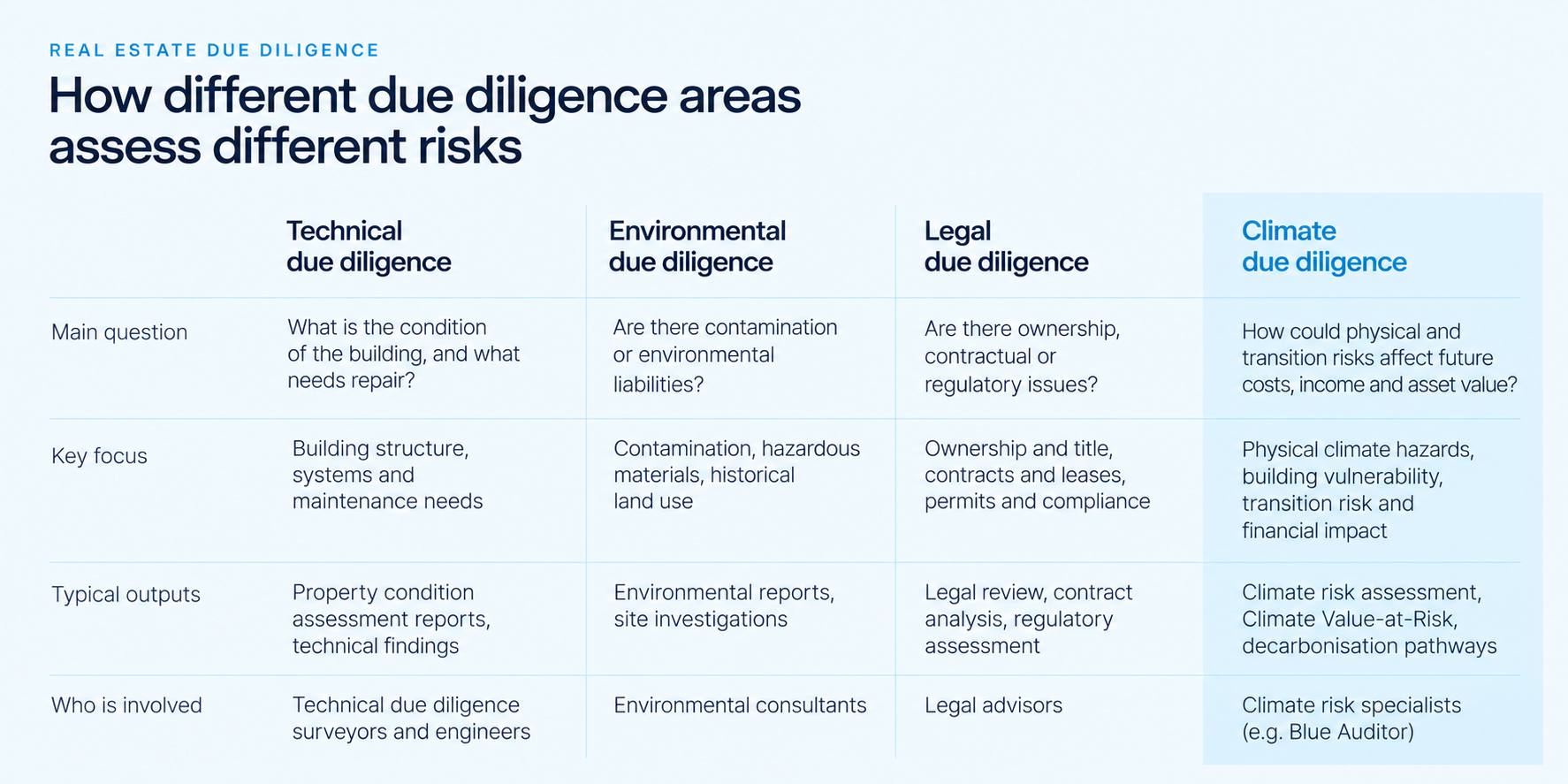
A property condition assessment report may confirm that the roof is in good condition and that no immediate structural repairs are necessary. An environmental assessment may find no significant contamination concerns. Neither result necessarily tells the investor whether future extreme rainfall could create a material flood risk, whether rising temperatures could increase cooling requirements or whether the building's energy performance creates significant future renovation costs.
These questions require a climate risk assessment.
The most efficient approach is to commission climate analysis alongside the existing technical and environmental assessments. That gives the acquisition team time to investigate material findings, obtain seller clarification and incorporate potential costs into underwriting before the final investment decision.
2. What should a climate due diligence assessment cover?
A useful climate assessment needs to go beyond a map showing whether a building is exposed to flooding or extreme heat. For investment purposes, the analysis should cover four connected areas.
Physical climate hazards
The first step is to identify which climate hazards could affect the property.
These may include river and coastal flooding, extreme precipitation, heat stress, drought, wildfire, storms, water stress and ground instability.
Under the EU Taxonomy, physical climate risk screening considers 28 climate-related hazard categories. Not every hazard will be material to every property, but the screening should be sufficiently broad to identify relevant risks rather than focusing only on the most obvious threats.
Building vulnerability
Exposure alone does not determine the financial consequences.
Two buildings in the same flood-risk area may have very different vulnerability profiles depending on their construction, technical systems, ground-floor use, protective measures and capacity to withstand or recover from damage.
A meaningful assessment therefore considers the relationship between the hazard and the building itself.
Future scenarios and time horizons
A property that appears relatively low-risk today may face a different risk profile in 2040 or 2050.
Climate projections allow investors to assess how exposure could change under different warming scenarios. The analysis should cover the intended holding period and consider the property's longer-term performance, particularly where future resale value or major renovation investments are relevant.
Blue Auditor uses Moody's climate data and IPCC Representative Concentration Pathway (RCP) scenarios to assess physical climate risks, with projections extending by decade to 2099. This allows investors to compare near-term exposure with risks that may become more significant later in the building's life.
Financial impact and transition risk
For an acquisition team, identifying a high-risk property is only the beginning. The next question is how that risk could affect the investment.
Physical climate risks may contribute to repair costs, business interruption, higher insurance expenses or adaptation requirements.
Transition risks can create additional financial pressure through energy performance requirements, decarbonisation investments, carbon-related costs and changes in market demand.
Climate Value-at-Risk (Climate VaR) helps translate modelled climate-related impacts into monetary terms, making it easier to compare exposure across assets and bring the findings into financial discussions.
Blue Auditor combines asset-level physical hazard assessment, building vulnerability and Climate VaR in euros with transition risk analysis and decarbonisation pathways.
The result is a clearer picture of which risks matter, when they may become material and what they could mean financially.
3. What information do you need from the seller?
One of the most common concerns during property due diligence is whether the climate assessment will require another extensive document request.
For an initial physical climate risk screening, the answer is generally no.
Location-based climate analysis can begin with relatively little information. The property's address or geographic coordinates allow climate datasets to identify exposure to relevant hazards across different scenarios and time horizons.
Additional information improves the assessment of building vulnerability, transition risk and potential financial impacts.
This distinction is particularly important when seller information is incomplete.
An initial climate screening can start before the full technical due diligence package is available. Missing building-specific information may require assumptions or limit the precision of certain outputs, but it does not necessarily prevent the acquisition team from identifying potentially material physical climate hazards.
As further information becomes available, the assessment can be refined.
For example, a flood exposure result may justify checking whether critical electrical equipment is located in the basement, reviewing existing flood protection or requesting information on previous damage.
The initial screening helps determine which additional questions are worth asking.
4. How long does climate risk due diligence take?
Speed is often the deciding factor in a live transaction.
Acquisition teams work within fixed exclusivity periods. A report that arrives after the final investment committee meeting may still be informative, but it has missed the moment when its findings could influence the deal.
The timing depends on the scope of the assessment.
An automated, location-based climate screening can be completed much faster than an extensive building-specific investigation requiring site inspections, engineering reviews or detailed financial modelling.
Blue Auditor's Climate VaR offering states that asset-level results for a set of ten properties can typically be returned within 24 hours from an address list.
That provides a practical starting point for an acquisition team working under time pressure. The subsequent review may take longer where additional building data, financial validation or specialist investigation is needed.
A sensible approach is to integrate climate assessment into the transaction process from the beginning.
For a typical transaction, the goal should be to obtain the first climate risk results early enough to influence the technical investigation and financial model, not to wait until every other due diligence report is finalised.
An early result also leaves time to commission targeted follow-up work where the exposure is significant.
For example, an initial screening may identify elevated flood risk. The acquisition team can then ask its technical advisor to investigate equipment locations, protective measures and potential damage mechanisms while the wider property condition assessment is still underway.
This is more efficient than discovering the issue immediately before signing.
5. How do you price climate risk into a real estate acquisition?
A high climate risk score should not automatically disqualify a property.
The relevant question is whether the identified risk is manageable, whether it creates additional costs and whether those costs are appropriately reflected in the investment case.
There are several possible responses.
Adjust the acquisition price
Where climate-related risks are expected to reduce future cash flows or terminal value, the acquisition model may need to reflect that impact.
For example, additional expected repair costs, higher operating expenditure or reduced exit liquidity could justify revisiting the purchase price.
Climate VaR provides a useful starting point for quantifying modelled losses, although its output should be reconciled with the investment team's valuation assumptions rather than automatically deducted from the bid.
Include a CapEx reserve
Some climate risks can be reduced through targeted adaptation investments.
Flood protection, drainage improvements, technical equipment relocation and cooling system upgrades may improve a building's resilience.
The acquisition team can assess the estimated cost of these measures and incorporate them into the capital expenditure plan.
Transition risk analysis may also identify energy-efficiency upgrades or decarbonisation investments that should be included in the business plan.
Review insurance availability and costs
Climate exposure can influence insurance pricing, coverage conditions and the availability of protection for certain hazards.
A material risk finding should prompt a review of the property's insurance arrangements, including exclusions, deductibles and possible premium changes.
A climate risk report does not replace an insurance assessment, but it can help identify where additional scrutiny is warranted.
Reconsider the investment
Some risks may be difficult or uneconomic to mitigate.
If projected losses are material, adaptation costs are disproportionate or insurance protection is inadequate, the investment committee may decide to reduce its offer or withdraw.
The purpose of climate due diligence is not to eliminate every exposed property from consideration. It is to ensure the investment team understands which risks it is accepting and at what price.
Example: How climate findings could change an acquisition
Consider a hypothetical €40 million office acquisition.
The initial technical due diligence identifies no major immediate repair requirements. However, the climate assessment highlights material future flood exposure and energy performance-related transition costs.
Further investigation produces the following illustrative investment assumptions:
- €350,000 for flood protection and drainage improvements.
- €900,000 for planned energy-efficiency upgrades.
- Additional potential insurance and operating costs to be reviewed in the financial model.
The acquisition team now has information that was not visible in the original property condition assessment reports.
It can negotiate on price, adjust its CapEx reserve, investigate the effectiveness of the proposed resilience measures or reconsider the investment.
The numbers are hypothetical, but the principle is straightforward: climate risk becomes more useful when it informs an actual financial decision.
6. What happens to the climate assessment after closing?
Climate due diligence should not become another PDF stored in the transaction archive.
The information collected during acquisition can support several decisions throughout the holding period.
EU Taxonomy assessment
The EU Taxonomy's climate adaptation criteria require the identification and assessment of relevant physical climate risks, together with consideration of appropriate adaptation solutions.
The technical screening criteria include climate risk and vulnerability assessments that are proportionate to the expected lifespan of the activity. For major investments with longer lifespans, they include climate projections covering at least 10 to 30 years.
A properly documented acquisition-stage climate assessment can therefore provide a valuable starting point for subsequent EU Taxonomy alignment work.
However, the assessment alone does not establish Taxonomy alignment. Relevant activity-specific criteria, mitigation measures and supporting evidence must also be considered.
Retrofit and decarbonisation planning
Transition risk findings can help identify which buildings may require substantial energy improvements, when those investments may become necessary and how they relate to the asset's expected holding period.
Combining climate resilience measures with planned energy renovations can also help avoid duplicated works and improve capital planning.
For example, a roof renovation may provide an opportunity to consider both energy performance and resilience to extreme weather.
Ongoing asset and portfolio management
Climate exposure can change over time as new projections, property information and adaptation measures become available.
Keeping the assessment current helps asset managers track material risks, compare properties and prioritise investment across the portfolio.
It also gives future buyers and lenders a more complete record of the asset's climate risk profile and the measures taken to manage it.
7. How Blue Auditor fits into the due diligence process
Acquisition teams rarely need another disconnected report. They need climate risk information that can be incorporated into an existing transaction workflow and used to support decisions.
Blue Auditor brings together asset-level climate exposure, building vulnerability, financial impact and transition risk analysis in one platform.
The analysis covers:
- 28 EU Taxonomy-aligned physical climate hazards, using Moody's climate data.
- IPCC RCP scenarios through 2099, allowing investors to examine different future risk conditions.
- Building-level vulnerability, considering sensitivity and adaptive capacity.
- Climate Value-at-Risk in euros, providing quantified physical risk impacts for individual properties and portfolios.
- Transition risk and CRREM pathways, helping identify decarbonisation exposure and future investment requirements.
- Adaptation and retrofit analysis, supporting resilience improvements and capital planning.
The initial analysis can begin with property locations, making it possible to introduce climate risk screening early in the acquisition process rather than waiting for the entire technical due diligence package.
Where material risks are identified, the results can guide more detailed investigation and support discussions between the acquisition team, technical advisors, asset managers and investment committee.
Climate risk belongs in the investment decision, not just the due diligence checklist
A property can pass its technical inspection, have no significant contamination issues and still carry material climate-related financial risks.
Those risks may not affect today's rental income, but they can influence future expenditure, insurance conditions, resilience investment and exit value.
The earlier they are identified, the more options the acquisition team has.
Climate due diligence is most valuable when the findings arrive before the investment decision and can be translated into actions: investigate further, reserve capital, negotiate the purchase price or reconsider the investment.
Evaluating a property acquisition?
Blue Auditor can help you assess physical and transition climate risks, quantify Climate Value-at-Risk and identify potential implications for your investment before closing.
Book a Blue Auditor demo to see how climate risk analysis can fit into your existing due diligence process.