
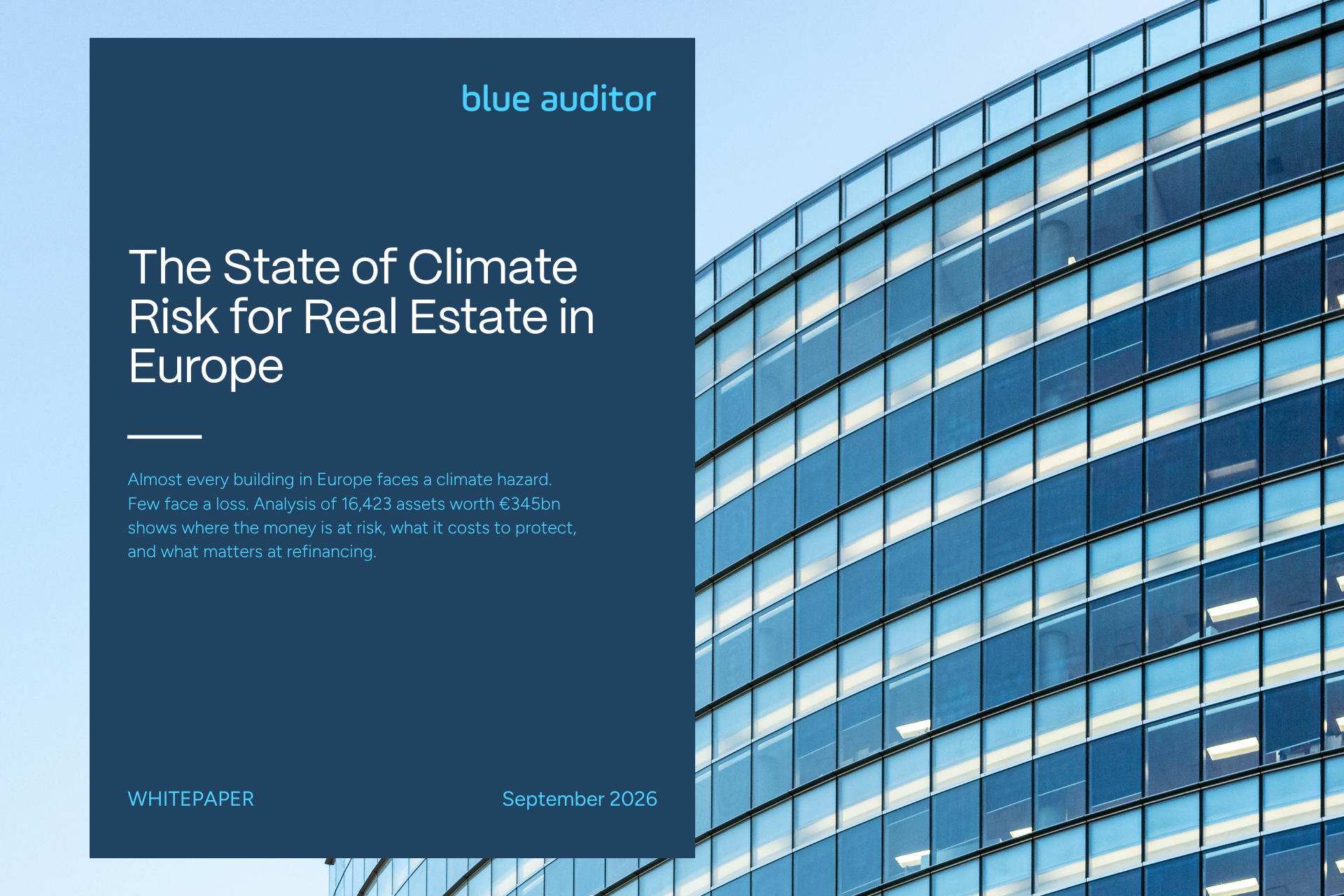
The State of Climate Risk for Real Estate in Europe
Climate risk is already embedded in European real estate portfolios, but the financial impact is far from evenly distributed.
Our analysis of 16,423 assets across 30 European markets, representing €345bn in gross asset value, shows that almost every building carries some level of climate hazard, while material financial loss is concentrated in a relatively small share of assets. At the same time, transition costs linked to energy performance and decarbonization pathways are becoming a growing part of the investment and refinancing equation.
In this report, we break down what climate risk means in practice for real estate owners, lenders, asset managers and investment committees, covering:
- Why 5% of assets account for 60% of expected physical climate loss
- Where physical risk is highest across European markets and which hazards dominate
- Why location can matter more than building age when assessing physical vulnerability
- How physical expected loss could rise from 0.13% of value in the 2030s to 0.47% in the 2050s
- Why 52% of assets with pathway data are already misaligned on an EPC basis
- The transition cost of meeting 2030 minimum standards, estimated at 7.9% of gross asset value
- How physical and transition risk combine into 8.3% Climate VaR to 2030
- What these numbers mean for refinancing, collateral value, CapEx planning and asset-level adaptation
With around €185bn of European commercial real estate debt maturing in 2026 and minimum energy performance requirements approaching in 2030, climate risk is increasingly becoming a financing and valuation question rather than a reporting exercise.
For portfolios being acquired, held or refinanced today, the priority is not simply to identify exposure. It is to understand which assets carry the loss, what it costs to address, and where action needs to happen first.
Download The State of Climate Risk for Real Estate in Europe 2026 to explore the full data and what it means for your portfolio.
Additional Resources
.png?width=2000&height=1125&name=Bewertung%20transitorischer%20und%20physischer%20Risiken%20nach%20EPBD-Mindestenergieanforderungen%20mit%20Climate%20VaR%20(14).png)
.png?width=2000&height=1125&name=Bewertung%20transitorischer%20und%20physischer%20Risiken%20nach%20EPBD-Mindestenergieanforderungen%20mit%20Climate%20VaR%20(15).png)