
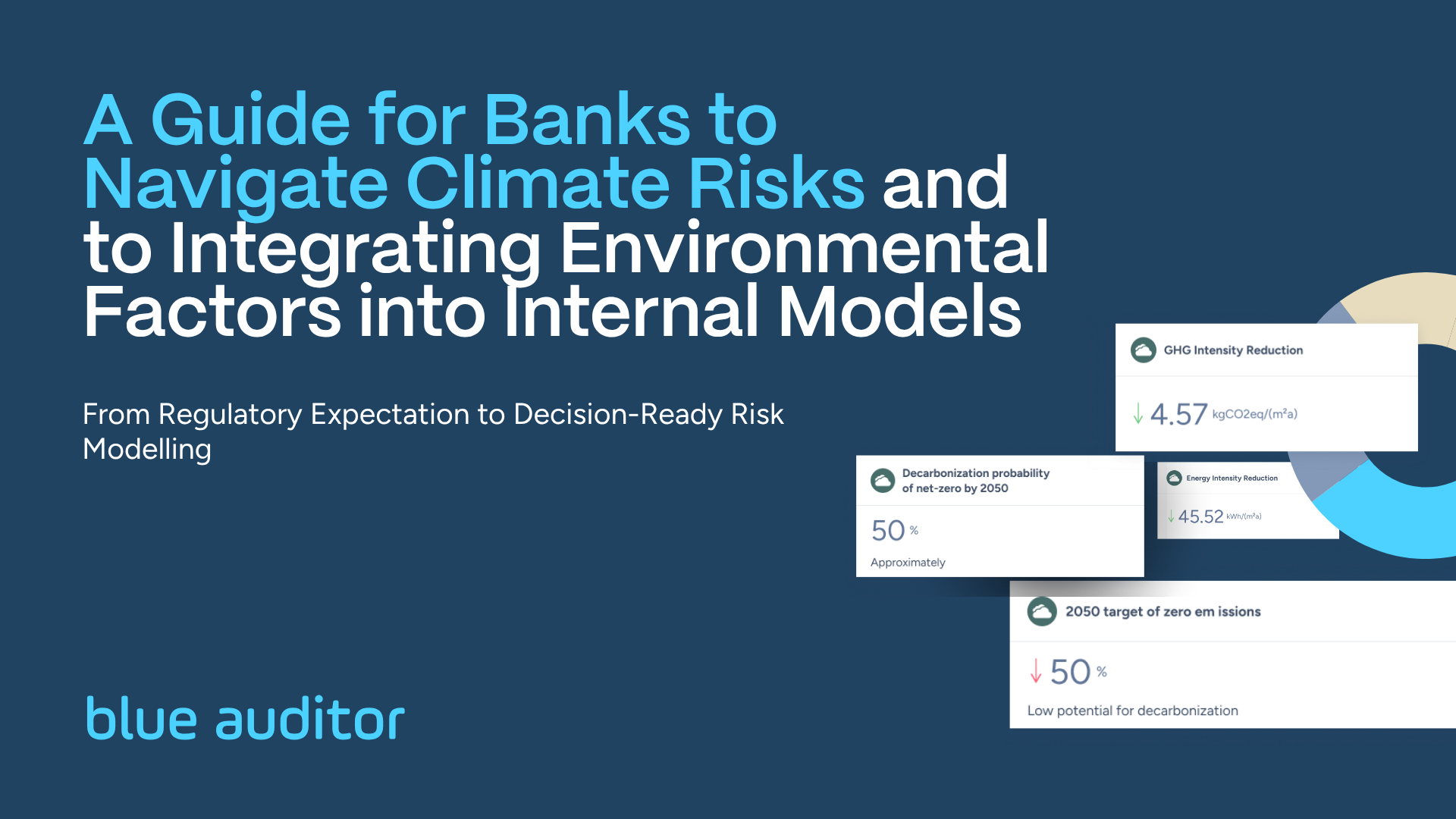
Climate risk for banks has shifted from a disclosure exercise to a core part of prudential risk management. As financial institutions face increasing exposure to climate-related and environmental risks, regulatory expectations are rapidly evolving, and lenders are now expected to fold these risks into the same internal models they use for credit, market, and operational risk. In response, the European Central Bank (ECB) has released comprehensive guidance to support banks in integrating these risks into their internal models.
These requirements have been strengthened and further developed through subsequent supervisory expectations and ECB climate work programmes. This process represents a critical step toward expanding risk management frameworks and ensuring long-term financial stability.
Why Climate Risk for Banks Is Now a Supervisory Expectation
The direction of travel is set by the supervisor. The ECB Banking Supervision framework treats climate-related and environmental risks as drivers of existing prudential risks rather than a separate, optional category. International bodies reinforce this: the Network for Greening the Financial System (NGFS) provides the reference climate scenarios that many banks use for stress testing. For banks, the practical question is no longer whether climate risk is material, but how to demonstrate, model, and govern it in a way that withstands supervisory review.
Understanding and Incorporating Materiality
At the core of the ECB's guidance is the requirement for banks to systematically assess the materiality of climate-related and environmental risks across the entire lifecycle of their internal models. This means that institutions must determine whether these risks have a significant financial impact on their portfolios, whether they influence key risk drivers within credit, market, and operational risk models, and whether they need to be explicitly incorporated into modelling approaches and capital frameworks.
A robust materiality assessment therefore serves as the foundation for a compliant and effective integration of these risks into the bank's risk management and decision-making processes.
A Structured Approach to Compliance
To align with ECB expectations, banks should adopt the following structured and forward-looking approach:
1. Materiality Assessment
Banks must conduct comprehensive and forward-looking analyses of climate-related and environmental risks, evaluating their relevance at every stage of the internal model lifecycle.
2. Integration into Internal Models
Where risks are deemed material, banks must incorporate relevant climate and environmental risk drivers directly into their internal models. This ensures:
- Accurate risk quantification
- Improved sensitivity to climate scenarios
- Enhanced decision-making
3. Impact on Own Funds Requirements
The inclusion of climate-related risks has direct implications for the calculation of capital requirements in both credit and market risk. Banks are therefore required to adjust their capital buffers accordingly and to incorporate forward-looking climate scenarios into their capital planning processes.
4. Governance, Compliance, and Reporting
Banks are required to update:
- Risk management frameworks
- Internal governance structures
- Reporting processes
This includes aligning disclosures and internal reporting with regulatory expectations and supervisory reviews.
5. Continuous Monitoring and Model Updates
Given the evolving nature of climate-related risks, banks must establish robust processes for regular model validation and recalibration, as well as continuous data updates. In addition, they need to ensure ongoing alignment with regulatory requirements.
By following this structured approach, banks can proactively manage the financial implications of climate change while strengthening the resilience of their portfolios and the broader financial system.
How Banks Assess Climate Risk in Real Estate Lending
Much of a typical bank's exposure sits in real estate, where both physical risk and transition risk land directly on collateral values. Flood, heat, and storm exposure can impair a building, while tightening energy rules can strand assets that fail to meet rising standards. Translating these hazards into credit terms is the practical core of integrating climate risk into bank internal models. We explore the underwriting side of this in from hazard maps to credit decisions and the quantification side in from hazard maps to financial impact. The transition-risk angle, including how upcoming building rules feed climate Value at Risk, is covered in EPBD 2026 and Climate Value at Risk.
Leveraging Technology for Effective Climate Risk Management
Blue Auditor provides a comprehensive platform designed to support banks in addressing climate risk requirements efficiently and at scale.
Our solution enables banks to:
- Assess loan portfolios for climate-related risks
- Identify ESG transition financing opportunities
- Benchmark assets and portfolios
- Automate CO2 emissions reporting
- Streamline risk assessment and regulatory reporting processes
Advanced Risk Modelling and Quantification
Blue Auditor supports the integration of environmental factors into internal models through highly granular, bottom-up methodologies.
This approach includes the simulation of climate-related hazard events across their full lifecycle, combined with detailed, location-specific hazard footprints that capture the physical exposure of individual assets.
These hazards are then translated into asset-level impacts using vulnerability curves, enabling a precise assessment of potential damage.
Building on this, Blue Auditor applies financial modelling to quantify the resulting effects, including repair and replacement costs as well as business interruption impacts.
This approach allows for accurate and transparent quantification of financial risk exposure.
Comprehensive Climate Risk and Vulnerability Assessment
The Blue Auditor platform provides a comprehensive assessment of climate-related impacts at the asset level. It evaluates the potential physical damage to buildings, technical equipment, and contents resulting from hazard events, while also quantifying the associated business interruption effects on revenue streams.
In addition, the platform captures indirect financial impacts, such as increases in operational costs, for example higher energy demand for cooling, thereby delivering a holistic view of risk and financial exposure.
Besides, we calculate Value-at-Risk (VaR) at asset and portfolio level, enabling banks to:
- Quantify exposure to individual climate risks
- Assess combined risk scenarios at specific locations
- Evaluate exposure over the lifetime of assets or lending terms
This results in bank-specific, forward-looking financial risk insights. These capabilities map directly to Blue Auditor's Risk & Resilience (Climate VaR) solution and are tailored for financial institutions that need to evidence climate risk in their internal models.
Driving Sustainability and Financial Resilience
Compliance with ECB guidelines is not only a regulatory necessity, it is a strategic opportunity.
By integrating climate risks into internal models, banks can:
- Strengthen resilience against environmental shocks
- Improve capital allocation decisions
Blue Auditor simplifies complex climate risk assessments into a scalable, efficient, and cost-effective solution, allowing banks to focus on strategic decision-making rather than manual analysis.
If you want to understand which assets in your portfolio are underperforming, what it would take to align them with EU Taxonomy requirements, and where capital can be deployed most effectively, book a demo with Blue Auditor.
We will show you how asset-level analysis connects building performance, regulatory requirements, and financial impact, so you can prioritise actions with confidence.

Frequently Asked Questions About Climate Risk for Banks
What does climate risk for banks mean?
Climate risk for banks refers to the financial risks that climate change creates for lenders, both physical risks such as floods and heat that damage collateral, and transition risks such as policy and market shifts that strand high-emission assets. The ECB expects banks to treat these as drivers of credit, market, and operational risk and to integrate them into their internal models and capital planning.
How do banks integrate climate risk into internal models?
Banks integrate climate risk into internal models by first running a materiality assessment across the model lifecycle, then incorporating material climate and environmental risk drivers into credit, market, and operational risk models, adjusting capital requirements, updating governance and reporting, and continuously validating and recalibrating the models as data and regulation evolve.
What are the ECB supervisory expectations on climate risk?
The ECB's Guide on climate-related and environmental risks sets out supervisory expectations covering business strategy, governance, risk appetite, risk management, and disclosures. Banks are expected to assess the materiality of these risks, embed them in internal models and stress testing, and demonstrate sound governance and forward-looking capital planning that can withstand supervisory review.
How do banks assess climate risk in real estate lending?
In real estate lending, banks assess climate risk by mapping the physical hazard exposure of each property, applying vulnerability curves to estimate potential damage and business interruption, and factoring transition risks such as tightening energy performance standards. These impacts are then translated into asset-level and portfolio-level Value at Risk to inform underwriting, pricing, and capital decisions.

.jpg?width=400&upsize=true&name=blogss%20visuals%20(1).jpg)